
How External Wall Insulation Systems Work
How External Wall Insulation Systems Work
A practical explanation of how EWI changes heat and moisture behaviour in solid‑wall homes
Many older properties around Northampton and across Northamptonshire were built with solid brick, stone or early blockwork walls. These structures cool down quickly, hold moisture for longer and often create cold internal surfaces during winter. External wall insulation works by placing insulation on the outside of the building and forming a continuous protective layer around the existing masonry. This changes how heat and moisture move through the wall and helps stabilise the building fabric over time.
1. The core principle — keeping the wall warm
In an uninsulated solid‑wall home, the masonry acts as a cold mass that continuously draws heat from inside the building.
When insulation is installed externally, the wall stays warmer and more stable throughout the year.
In practice, this usually means:
internal wall surfaces no longer feel cold
room temperatures become more consistent
cold corners and localised condensation are reduced
freeze–thaw stress on the masonry is reduced
the wall dries more predictably through winter months
If you want a deeper explanation of how heat and moisture move through masonry, we explain this in our guide to moisture behaviour in solid‑wall construction.
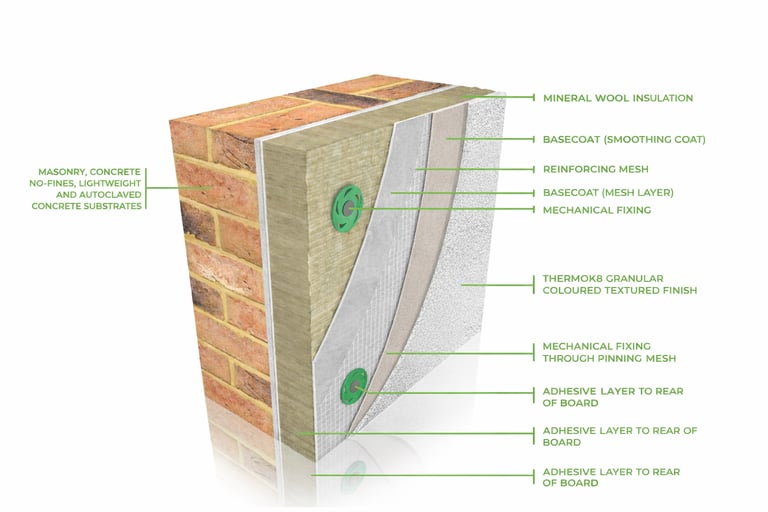
2. How a full EWI system is built
External wall insulation is not a single product.
It is a layered system designed to work as one complete assembly.
A typical system includes:
Existing wall
The original brick, stone or blockwork structure.
Its condition, coatings and exposure influence how the system is specified.
Adhesive and mechanical fixings
Boards are fixed using a combination of adhesive and mechanical anchors.
Fixing patterns depend on substrate strength, wind exposure and insulation type.
Insulation layer
Most systems use either EPS or mineral wool.
Each material behaves differently in terms of thermal performance, moisture behaviour and fire classification.
If you want a deeper comparison, we explain this in our EPS vs mineral wool guide.
Reinforced basecoat with mesh
Provides impact resistance, crack control and overall system strength.
Primer
Stabilises the basecoat and ensures consistent finish adhesion.
Final finish
Typically a silicone render or brick‑slip system, providing weather protection and final appearance.
System performance depends on how well all layers work together rather than any single component.
3. How EWI changes heat flow through the wall
Without insulation, heat moves quickly through solid masonry and the internal surface becomes cold.
With external insulation installed:
the thermal gradient shifts outward
the internal wall surface stays warm
the masonry becomes part of the insulated envelope
overall heat loss is reduced
This is why homes often feel more stable after EWI — not because rooms are overheated, but because surfaces stop acting as heat sinks.
If you want a technical comparison of how this differs from other insulation methods, we explain this in our EWI vs IWI vs CWI comparison.
4. How EWI changes moisture behaviour
Solid masonry naturally absorbs moisture from rain, humidity and ground contact.
When walls stay cold, moisture tends to remain in the structure for longer periods.
External insulation helps by:
keeping the wall temperature more stable
reducing the time moisture remains in the masonry
lowering condensation risk within the wall build‑up
reducing freeze–thaw stress in colder months
The system does not seal the wall — it stabilises its drying behaviour.
Moisture still moves, but in a more predictable way.
For a deeper explanation of this process, we cover it in our solid‑wall moisture behaviour guide.
5. Why detailing is critical
Long‑term performance depends heavily on correct detailing, including:
substrate preparation
exposure conditions and orientation
insulation type selection
fixing density and layout
reinforcement positioning
detailing at windows, sills and junctions
correct finish application
Small detailing failures — especially around openings — are where most long‑term problems start.
6. Where EWI is typically suitable
External insulation is commonly used on:
solid brick construction
stone walls
blockwork
some cavity walls (depending on condition and design)
Suitability always depends on substrate condition, exposure level and moisture behaviour.
We explain typical construction types in more detail in our guide to which walls can use external wall insulation.
7. What homeowners usually notice after installation
Most clients describe similar changes:
more stable room temperatures
fewer cold surfaces and corners
reduced heating demand
less seasonal damp feeling internally
a renewed external façade finish
These are natural results of stabilising the wall and improving the building envelope.
If you’re considering EWI
Every building behaves differently.
The only reliable way to assess suitability is to look at the property itself — wall construction, exposure, existing coatings and detailing all matter.
If you’re considering external wall insulation for your property, we’re always happy to look at the building and talk through options in a straightforward, practical way.






© 2025. All rights reserved.
insulating homes for efficiency, comfort, and peace of mind.




Call US 01604422352
Contact Us